Mission Australia’s Saltwater Kitchen social enterprise has plenty on its plate, with more requests for catering coming in each week.
Based in Darwin, this commercial catering business provides practical training and work experience to disadvantaged jobseekers. Now in its second year of operation, the business is thriving, and recently catered for a 130-person event at the Darwin Museum.
Saltwater Kitchen currently employs 18 trainees, who are all undertaking or have just completed their Certificate II in Hospitality.
“Some of our trainees have never had a job let alone knowing what responsibilities having a job entails,” said Enterprise Development Manager, John Vreeling.
“The program is a real success and you can see it in our participants. Many commence with little or no self confidence and at the end of the 26 weeks you can really see a positive change.”
Trainees are employed for a period of approximately 26 weeks. During this time they rotate work locations between any of the three local primary school canteens and Saltwater Kitchen. During this time they are mentored and supported by our Canteen Managers – one of whom is a former trainee of the program – and Saltwater Kitchen’s resident Head Chef, Leigh Harding.
Saltwater Kitchen is operated by Mission Australia as part of the Changing Places Innovation Fund, which is delivered by the Department of Education Employment and Workplace Relations.
Photo: from left, John Vreeling (Enterprise Development Manager) with trainees Dwayne Wilson and Sarah-Jane Walkington at the Darwin Museum function earlier this month.
Showing posts with label social enterprise. Show all posts
Monday, August 15, 2011
Sunday, February 27, 2011
Enterprising young men lend a hand after Yasi
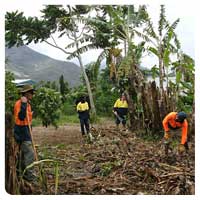
Here’s a very welcome good news story from Queensland. Seven young Indigenous Employment Program participants from Cairns recently volunteered their time to help elderly locals clean up after Cyclone Yasi, which swept through late last month.
The young men, who are gaining landscaping and construction skills through Djarragun Enterprises, contacted the local RSL offering to clear vegetation and debris from the yards of elderly people in the community.
They subsequently helped residents in Gordonvale and Mission Beach, clearing their properties and bringing their yards back to a condition that would be easier for them to maintain in the future.
In Gordonvale, they helped clear a mini banana plantation from the backyard of a 92-year-old war veteran. The Djarragun Enterprises crew took two days of hard work to clear damaged plants and prepare the area for re-growth. In the process, the team bonded with the home owner and offered to help her on an ongoing basis.
The young men also travelled down to Mission Beach and spent the day offering what assistance they could, free of charge. The day started early for the crew, who left at 6am for the trip and arrived home after 7pm.
“As the emphasis of the program is to equip our participants to operate in mainstream society, it was a valuable opportunity for them to experience the benefits of giving freely of their time and energy to assist others less fortunate,” said Programs Manager Steve Burrowes.
Djarragun Enterprises is an Indigenous Employment Program social enterprise that operates out of Cairns. Funded by the Department of Education, Employment and Workplace Relations (DEEWR), this 15-month program provides an industry-based employment pathway for Indigenous graduates from Djarragun College.
Three Mission Australia live-in support staff work closely with participants at their accommodation, helping them to develop social skills and ensure they are self-sufficient and assisted to make the transition into permanent employment.
Mission Australia also provides post-placement and employment support to young people who complete training with Djarragun Enterprises.
The young men, who are gaining landscaping and construction skills through Djarragun Enterprises, contacted the local RSL offering to clear vegetation and debris from the yards of elderly people in the community.
They subsequently helped residents in Gordonvale and Mission Beach, clearing their properties and bringing their yards back to a condition that would be easier for them to maintain in the future.
In Gordonvale, they helped clear a mini banana plantation from the backyard of a 92-year-old war veteran. The Djarragun Enterprises crew took two days of hard work to clear damaged plants and prepare the area for re-growth. In the process, the team bonded with the home owner and offered to help her on an ongoing basis.
The young men also travelled down to Mission Beach and spent the day offering what assistance they could, free of charge. The day started early for the crew, who left at 6am for the trip and arrived home after 7pm.
“As the emphasis of the program is to equip our participants to operate in mainstream society, it was a valuable opportunity for them to experience the benefits of giving freely of their time and energy to assist others less fortunate,” said Programs Manager Steve Burrowes.
Djarragun Enterprises is an Indigenous Employment Program social enterprise that operates out of Cairns. Funded by the Department of Education, Employment and Workplace Relations (DEEWR), this 15-month program provides an industry-based employment pathway for Indigenous graduates from Djarragun College.
Three Mission Australia live-in support staff work closely with participants at their accommodation, helping them to develop social skills and ensure they are self-sufficient and assisted to make the transition into permanent employment.
Mission Australia also provides post-placement and employment support to young people who complete training with Djarragun Enterprises.
Labels:
aboriginal,
Cyclone Yasi,
DEEWR,
employment,
indigenous affairs,
mission australia,
social enterprise,
volunteer
Wednesday, January 19, 2011
Saltwater Kitchen welcomes new head chef and trainees
Mission Australia’s Saltwater Kitchen has welcomed a new Head Chef, Leigh Harding, who is sharing 30 years’ worth of culinary knowledge with the Darwin social enterprises’s latest intake of trainees.
The catering business supplies fresh, healthy food to school students, local businesses and government departments while providing practical training and work experience to local disadvantaged job seekers.
Head chef Leigh has worked in the hospitality industry for three decades, including six years teaching Commercial Cookery at Charles Darwin University. He also has experience delivering training to remote Aboriginal communities.
The 17 new trainee recruits began their pre-employment training this week in preparation for the start of the school year next Tuesday.
“We’ve got a great crew on board this year,” said Mission Australia Enterprise Development Manager Lawson Broad. “The trainees are all looking forward to putting their new skills into action next week.”
Saltwater Kitchen currently caters for Sanderson Middle School, Rosebery Middle School, Rosebery Primary School and Millner Primary School and recently moved into Nightcliff Middle School. The training kitchen at Nightcliff has proved to be the ideal base for Saltwater Kitchen’s high-quality catering business.
Mission Australia has also recruited three more Canteen Managers to Saltwater Kitchen, given the growing numbers of schools the social enterprise is catering to.
Saltwater Kitchen is operated by Mission Australia as part of the Changing Places Innovation Fund, which is deliverd by the Department of Education Employment and Workplace Relations.
The catering business supplies fresh, healthy food to school students, local businesses and government departments while providing practical training and work experience to local disadvantaged job seekers.
Head chef Leigh has worked in the hospitality industry for three decades, including six years teaching Commercial Cookery at Charles Darwin University. He also has experience delivering training to remote Aboriginal communities.
The 17 new trainee recruits began their pre-employment training this week in preparation for the start of the school year next Tuesday.
“We’ve got a great crew on board this year,” said Mission Australia Enterprise Development Manager Lawson Broad. “The trainees are all looking forward to putting their new skills into action next week.”
Saltwater Kitchen currently caters for Sanderson Middle School, Rosebery Middle School, Rosebery Primary School and Millner Primary School and recently moved into Nightcliff Middle School. The training kitchen at Nightcliff has proved to be the ideal base for Saltwater Kitchen’s high-quality catering business.
Mission Australia has also recruited three more Canteen Managers to Saltwater Kitchen, given the growing numbers of schools the social enterprise is catering to.
Saltwater Kitchen is operated by Mission Australia as part of the Changing Places Innovation Fund, which is deliverd by the Department of Education Employment and Workplace Relations.
Labels:
darwin,
DEEWR,
northern territory,
Saltwater Kitchen,
social enterprise,
training
Tuesday, January 18, 2011
PhD Scholarship – Capacity Building and Social Enterprise
Mission Australia and Deakin University are calling for expressions of interest in a full-time APA(I) PhD Scholarship commencing in April 2011. The PhD candidate will work on a three-year project: Capacity Building and Social Enterprise: Individual and Organisational Transformation in Transitional Labour Market Programs.
The research will investigate the Transitional Labour Market Program (TLMP) operating at Mission Australia’s Charcoal Lane restaurant in Melbourne’s Fitzroy. The TLMP provides training and support for unemployed Aboriginal and non-Aboriginal youth.
The research program consists of two studies. The study that will form the major component of the PhD project will take a longitudinal qualitative approach to identifying factors that influence young program participants’ experiences and outcomes. This research will provide insights into how social enterprises can support marginalised young people’s transition into employment in industries facing labour and skill shortages.
The second study, conducted by the broader Mission Australia and Deakin research team, is an action research project that will examine the organisational practices of this enterprise with the aim of understanding and explaining the factors that contribute to its sustainability.
What we want
As part of the larger research program, the PhD project will develop detailed biographies of young people’s pathways into the program, their participation in it and destinations beyond.
We are looking for a graduate in the Social Sciences (Anthropology, Education, Gender Studies, Sociology or Youth Studies) with an Honours degree (H1 or H2A). The candidate should have an interest and/or background in qualitative, biographical methodologies and a concern for the social justice issues related to marginalised young people.
Suitably qualified persons from the Aboriginal and Torres Strait Islander communities are encouraged to register their Expression of Interest.
The successful candidate will work from Deakin University’s Waterfront Campus in Geelong under the supervision of Associate Professors Peter Kelly (Centre for Comparative Social Research) and Lyn Harrison (Alfred Deakin Research Institute and School of Education).
If you are interested, please email your CV (two-page maximum) to Associate Professor Lyn Harrison at lyn.harrison@deakin.edu.au, and include your contact details, educational and employment history, and a brief paragraph outlining the reasons for your interest in the project.
Expressions of Interest close 28 February, 2011
Thursday, January 13, 2011
Opinion: Private capital can be key to social change
There are plenty of social services we should pay for out of basic human decency, despite the cost.It’s what Australians like to call ‘giving people a fair go’.
What most of us fail to realise, is that many social services can also show a significant return on investment over time.
And in a surprise turn, it’s the much maligned NSW Government that has lead the country by announcing the trial of Australia’s first Social Impact Bond (SIB); a financial instrument designed to provide capital to successful social programs which show a return to investors.
The SIB trial will be modelled on a similar program in the UK and will require the cooperation of government, investors and the community sector.
The principle is fairly simple.
Governments fund social programs which save them money – they’re just not good at quantifying it, particularly when the returns will come years down the track.
In the juvenile justice area for example, there are inexpensive and successful diversionary programs aimed at reducing rates of recidivism.
Reducing recidivism saves the cost of incarceration, which in NSW is around $150,000 to keep one young person locked up for a year.
Our own research shows that by reducing reoffending and time spent in jail, you also reduce adverse health and welfare outcomes and increase the rate of employment, which not only saves money but increases revenue through income tax and GST.
Unfortunately the money available from governments to scale this kind of program is more often than not tied up in the aftermath of ‘tough on crime’ sentencing and providing detention.
But by issuing a SIB, it opens opportunities for private investment.
For example, the government sells the bond – linked to a juvenile justice program - to private investors.
If the program achieves an agreed reduction in recidivism, then the government pays a return to the investor on top of their original debt obligations.
The NSW Government is estimating savings of between $4 and $17 for every $1 it invests which suggest there’s plenty of potential upside to cover the costs and then some.
It’s a wide range, but it’s a new area and there’s still lots of hard work to be done.
For one, investors and government will need to build their capacity to run the ruler over social programs the way they do with potential commercial investments.
Which funds manager will advise a retiree to invest in a social bond if they have no idea if the ‘business’ behind it is sound?
There’s also a question about who carries the risk – is this really a social bond or are you buying equity so that if the program fails you do your dough?
We also need to be wary of the fact that these are people’s lives we’re talking about – we’re not investing in widgets. Any development of SIBs needs to be based on a sophisticated understanding of the issues involved and their impact on individuals, families and communities.
But we shouldn’t allow the prospect of hard work and the need for deeper examination to dissuade us from pursuing SIBs; there are some very attractive features of creating this kind of tradable instrument.
Capital will naturally flow to the most successful programs.
It should encourage innovation, because investors can choose to put money into interesting projects politicians could struggle to get through Treasury or justify to voters…however strong the case.
Community service providers will be pushed to demonstrate tangible outcomes rather than outputs – something we shouldn’t be afraid to do.
And it provides another product for the burgeoning ethical investment market, which will in turn help increase the pool of private capital available to fund successful social programs.
Most importantly, it will allow larger-scale investment with long-lead returns which the three or four year government cycle makes nigh on impossible.
SIBs won’t solve every problem, but you’d be surprised how much money could be saved by investing upfront in solving social ills rather than perpetuating them.
Homelessness, early interventions for children with disabilities and treating people with a mental illness are all areas where investing now can show great returns in the long run.
We use bonds to fund rail and road – so why not social infrastructure?
Toby Hall is the Chief Executive Officer of Mission Australia
This piece was published in the National Times on 14 January
Wednesday, October 13, 2010
Opinion: Wrong sort of record to set on young jobless
Victoria has the highest youth unemployment in the country. Why?
Melbourne's north-west achieved a dubious distinction in the latest unemployment data - it has the worst youth unemployment rate in Victoria.
In the region - bounded by the suburbs of Brunswick, Sunbury and Kalkallo - 55 per cent of 15 to 19-year-olds are not in full-time work or education. Even more concerning, Victoria now has the worst youth unemployment rate in the country at 28 per cent.
And yet the irony is the state continues to deliver some of the best jobs growth in the country.
So what's going on? Why are so many young Victorians out of work - or not in touch with education and training - and why is the situation getting worse?
As politicians and media focus on Australia's ability or luck in avoiding the ravages of the global financial meltdown - and the potential for a new economic boom - it's worth reflecting on how we've allowed a situation like this to develop and what we can do about it.
Historically, young Australians bear a disproportionate burden during economic crises. They also have the least resources to fall back on and are the last to benefit when things pick up.
That's because during a downturn it's the casual, part-time and lower skilled jobs in the labour market - the type of jobs young people rely on - that are first to go and the last to return.
We also know through our research and experience in Melbourne's disadvantaged communities that there is a growing disconnect between labour supply and demand.
Businesses need job-ready applicants with minimal fuss. The steadily rising tide of young job seekers don't have the employability skills required.
Beset by a range of challenges in their families and communities - domestic violence, family conflict and truancy - it's no wonder that youth unemployment is growing and perpetuating a cycle of disadvantage as these young men and women grow up and have children of their own.
How can we start turning things around? A local area-based, employer-first, co-ordinated approach is required that identifies job needs, builds trust with businesses and focuses on transitions to work for young people so they can fill available vacancies.
The jobs are there; we need to make sure that young people have the capacity to take them. The tough news is that building up this sort of approach takes time, perseverance, innovation and resources. The key is integrated programs that offer structured work experience, support to overcome non-vocational barriers, and appropriate training that fill the requirements of local industries.
These young people are not going to be perfect employees immediately. They need to be given an environment to make mistakes, appreciate the value of a wage and receive support from mentors and a new peer group.
Programs that provide all these things, and also link business, training, employment and community service organisations, are not easy, fast or traditional.
One example where it's working is with Jayco, which, along with other Dandenong businesses, has been partnering with Mission Australia to move unemployed young Sudanese men into local jobs - an initiative supported by the Victorian government and two progressive philanthropic trusts, the Felton Bequest and the Bennelong Foundation.
It has been a challenging process but the efforts are starting to bear fruit, as these young job seekers take up positions with Jayco and other local employers and begin their careers.
There's no silver bullet - this particular initiative has taken two years of hard work to put together - but that's the sort of commitment required if we are serious about breaking the back of this problem.
Another approach is the use of social enterprises: projects that combine a commercial business with personal support and training. They are notoriously difficult to get up and running, but over the past three years Mission Australia's Urban Renewal landscaping and construction business has enabled more than 100 early school leavers to enter careers in trades by giving them experience.
Another idea being trialled in Britain is private investors investing in ''social impact bonds''. Such bonds are about attracting non-government investment for community programs that otherwise would not get off the ground for lack of government funding.
Returns for investors come via a proportion of the government funds that are saved from not having to provide a range of other acute related support.
For example, by investing in bonds, businesses could benefit from accessing some of the funds government saves on income support because the young person is now in a job.
It is important to remember we all have a stake in this. Governments can provide the resources and policy settings but businesses, community agencies and individual families need to be prepared to put in the hard graft to arrive at a solution.
The bottom line is our businesses need workers and our young people need to work.
Paul Bird is Mission Australia's Victorian state director
This piece was published in The Age on 14th October 2010
Melbourne's north-west achieved a dubious distinction in the latest unemployment data - it has the worst youth unemployment rate in Victoria.
In the region - bounded by the suburbs of Brunswick, Sunbury and Kalkallo - 55 per cent of 15 to 19-year-olds are not in full-time work or education. Even more concerning, Victoria now has the worst youth unemployment rate in the country at 28 per cent.
And yet the irony is the state continues to deliver some of the best jobs growth in the country.
So what's going on? Why are so many young Victorians out of work - or not in touch with education and training - and why is the situation getting worse?
As politicians and media focus on Australia's ability or luck in avoiding the ravages of the global financial meltdown - and the potential for a new economic boom - it's worth reflecting on how we've allowed a situation like this to develop and what we can do about it.
Historically, young Australians bear a disproportionate burden during economic crises. They also have the least resources to fall back on and are the last to benefit when things pick up.
That's because during a downturn it's the casual, part-time and lower skilled jobs in the labour market - the type of jobs young people rely on - that are first to go and the last to return.
We also know through our research and experience in Melbourne's disadvantaged communities that there is a growing disconnect between labour supply and demand.
Businesses need job-ready applicants with minimal fuss. The steadily rising tide of young job seekers don't have the employability skills required.
Beset by a range of challenges in their families and communities - domestic violence, family conflict and truancy - it's no wonder that youth unemployment is growing and perpetuating a cycle of disadvantage as these young men and women grow up and have children of their own.
How can we start turning things around? A local area-based, employer-first, co-ordinated approach is required that identifies job needs, builds trust with businesses and focuses on transitions to work for young people so they can fill available vacancies.
The jobs are there; we need to make sure that young people have the capacity to take them. The tough news is that building up this sort of approach takes time, perseverance, innovation and resources. The key is integrated programs that offer structured work experience, support to overcome non-vocational barriers, and appropriate training that fill the requirements of local industries.
These young people are not going to be perfect employees immediately. They need to be given an environment to make mistakes, appreciate the value of a wage and receive support from mentors and a new peer group.
Programs that provide all these things, and also link business, training, employment and community service organisations, are not easy, fast or traditional.
One example where it's working is with Jayco, which, along with other Dandenong businesses, has been partnering with Mission Australia to move unemployed young Sudanese men into local jobs - an initiative supported by the Victorian government and two progressive philanthropic trusts, the Felton Bequest and the Bennelong Foundation.
It has been a challenging process but the efforts are starting to bear fruit, as these young job seekers take up positions with Jayco and other local employers and begin their careers.
There's no silver bullet - this particular initiative has taken two years of hard work to put together - but that's the sort of commitment required if we are serious about breaking the back of this problem.
Another approach is the use of social enterprises: projects that combine a commercial business with personal support and training. They are notoriously difficult to get up and running, but over the past three years Mission Australia's Urban Renewal landscaping and construction business has enabled more than 100 early school leavers to enter careers in trades by giving them experience.
Another idea being trialled in Britain is private investors investing in ''social impact bonds''. Such bonds are about attracting non-government investment for community programs that otherwise would not get off the ground for lack of government funding.
Returns for investors come via a proportion of the government funds that are saved from not having to provide a range of other acute related support.
For example, by investing in bonds, businesses could benefit from accessing some of the funds government saves on income support because the young person is now in a job.
It is important to remember we all have a stake in this. Governments can provide the resources and policy settings but businesses, community agencies and individual families need to be prepared to put in the hard graft to arrive at a solution.
The bottom line is our businesses need workers and our young people need to work.
Paul Bird is Mission Australia's Victorian state director
This piece was published in The Age on 14th October 2010
Labels:
Australians,
Brunswick,
community services,
domestic violence,
employment,
homeless,
job placement,
Kalkallo,
melbourne,
mission,
mission australia,
opinion,
social enterprise,
Sunbury,
VIC,
youth
Wednesday, March 3, 2010
Functions are on the menu at Charcoal Lane

Mission Australia's social enterprise restaurant, Charcoal Lane, has recently opened its private dining room catering for groups of up to 20 people, offering a personalised seasonal menu.
The restaurant, located in Melbourne's trendy Fitzroy, now caters for up to 100 guests and has been attracting attention locally and internationally for it's role as a training provider to culinary students of disadvantaged backgrounds and its unique Modern Australian cuisine combining native influences.
The new private dining room will help build Charcoal Lane's reputation as a first-class fine dining venue, ensuring it can provide employment pathways for it's students in the future.
For bookings or enquiries call: (03) 9418 3400 or visit www.charcoallane.com.au/contact/booking
Labels:
charcoal lane,
Fitzroy,
indigenous affairs,
kg,
melbourne,
mission australia,
social enterprise,
training,
VIC,
youth
Sunday, February 14, 2010
Charcoal Lane making waves around the world

The UK's influential Guardian newspaper recently featured Melbourne's shopping and tourist attractions in its travel section. Among the attractions labelled 'not to be missed' was Mission Australia's own Charcoal Lane restaurant.
Charcoal Lane aims to provide a career path into the hospitality industry for marginalised and unemployed young people, many of who come from an Aboriginal background.
Further Reading:
- Read the Guardian's article here: www.guardian.co.uk/travel...
- Recent review by The Age: www.theage.com.au/news/entertainment...
Labels:
charcoal lane,
Fitzroy,
guardian,
guardian.co.uk,
indigenous affairs,
kg,
melbourne,
mission australia,
review,
social enterprise,
training,
VIC,
youth
Tuesday, January 19, 2010
Charcoal Lane wins rave review in The Age

Frequent visitors to Mission Australia's website will know of our terrific new Melbourne initiative, Charcoal Lane.
Developed by Mission Australia with support from the Victorian Government and the Victorian Aboriginal Health Service, Charcoal Lane is a 'social enterprise' restaurant that combines a top-flight dining experience with a transitional labour market program designed to assist disadvantaged young people – mainly from Aboriginal backgrounds – develop professional skills for a career in hospitality.
Opened in July 09, Charcoal Lane has already been an outstanding success giving Melburnians and visitors to the city a taste of contemporary Aboriginal food and culture while providing crucial training and mentoring.
Recently The Age's restaurant critic, Nina Rousseau, visited Charcoal Lane and was suitably impressed labelling her experience "bloody good".
Read the review here and be sure to make a booking at Charcoal Lane the next time you're in Melbourne!
Labels:
charcoal lane,
Fitzroy,
indigenous affairs,
kg,
melbourne,
mission australia,
review,
social enterprise,
The Age,
training,
VIC,
youth
Wednesday, December 16, 2009
Charcoal Lane featured in The Age's (Melbourne) Magazine

Charcoal Lane, Mission Australia's social enterprise restaurant in Melbourne's Fitzroy, has featured in The Age's award-winning (Melbourne) Magazine.
Charcoal Lane is a unique new restaurant that embodies the theme of indigenous cooking in a modern setting. The menu blends international cooking with indigenous ingredients, with items such as salmon wildfire terrine with desert limes and crème fraiche, or kangaroo fillet with rosella flower jus - view the menu here.
While boasting the innovative menu, the restaurant employs up to 32 apprentices and trainees, who are mainly of Aboriginal and Torres Strait Island descent. The social enterprise aims to help disadvantaged young people acheive their life goals through education, training and teamwork.
Learn more about this unique social enterprise at the new Charcoal Lane website: www.charcoallane.com.au
Labels:
(Melbourne) Magazine,
apprentice,
charcoal lane,
Fitzroy,
kg,
melbourne,
mission australia,
review,
social enterprise,
The Age,
training,
youth
Monday, October 19, 2009
SBS's Living Black program covers our social enterprise cafe - Charcoal Lane
Last night SBS's Living Black program ran a story on Mission Australia's social enterprise cafe, Charcoal Lane.Through the concept of social enterprise, Charcoal Lane aims to transform the lives of Aboriginal and disadvantaged young people who enrol in our program and see them achieve their life goals through the power of education, training and working together as a team.
Every year, the Charcoal Lane program will give Aboriginal and disadvantaged young people the opportunity to develop their professional and life skills to transition into a career in hospitality and other mainstream employment.
Further Reading:
- Click here to view SBS's Living Black story on Charcoal Lane at the SBS website
- Location: 136 Gertrude Street, Fitzroy, Victoria. For opening hours or bookings call (03) 9418 3400 or visit www.charcoallane.com.au
Labels:
charcoal lane,
indigenous affairs,
kg,
living black,
review,
sbs,
social enterprise
Monday, October 12, 2009
Opinion: Charities capitalise on business to fight poverty
With over 20,000 homeless people in Victoria, we need to rethink our strategies to combat the rise of poverty in our society.
Whether we like it or not, the gap between those who have and those who have not is growing.
Enter social enterprise – a proven method in the fight against injustice, inequity and disadvantage in communities around the world.
Many charities are using the power of social enterprise to harness commercial businesses as their modus operandi. These businesses are driven not by profit, but by opportunity – giving those without power and voice a chance to participate in on equal terms.
Last week, 600 devoted social innovators from across the globe came to Melbourne to discuss emerging trends, successful models and cutting edge techniques to decrease the rise of poverty throughout the world. These international experts were seeking an innovative marriage of business and charity – the merging of market with social purpose.
Social enterprises unite communities to get a fairer deal. When exploitative factory owners and shopkeepers charged exorbitant prices in England in the industrial revolution 150 years ago, a group of workers established their own shop to provide quality and affordable food to their community and the first social enterprise was born.
Through the support of governments, the last fifteen years has seen a resurgence in social enterprise. The value of social enterprise has been recognised as the combination of local agencies and passionate people understanding local needs. Coupled with an entrepreneurial and creative approach, bit-by-bit these businesses are effectively responding to the needs of disadvantaged communities.
By providing services where little or none existed, social enterprises can give communities the public services it needs. By creating jobs for unemployed people excluded from the labour market due to their low level of educational attainment and life skills, such as early school leavers, social enterprises provide real work experience, training and allow a sustainable pathway to employment.
The most successful economies from around the world have adopted the social enterprise ethos. From coffee to construction, from landscaping to logistics, from packaging to painting, from markets to manufacturing, from recycling to repairs, from nurseries to newspapers, from hotels to health, from gyms to geraniums, from insurance to funeral homes, there are over 55,000 social enterprises in the United Kingdom alone.
The largest credit union in Canada, Vancity Credit Union has 310,000 members and provides financial support to people who have been ignored or forgotten by the larger commercial banks as well as helping charities to build their own asset base.
The world’s largest social enterprise, the Mondragón Corporacion Cooperativa in Spain, comprises 120 companies, employs 42,000 worker-owners, runs 43 schools and one college, generates more than $4.8 billion annually in manufacturing, services, retail and wholesale distribution, and administers more than $5 billion in financial assets.
Over the last ten years in Australia, the South Australian and Victorian Governments have led the recognition and revival of social enterprises, ably assisted by groups that target and sponsor unique and viable social enterprise ideas, like Social Traders.
Initially through training programs, not-for-profit groups such as Mission Australia have set up social enterprises that provide opportunities for disadvantaged and jobless Australians to get a job.
Trainees are offered integrated personal skills development and accredited training that aims to enable the transition to sustainable mainstream employment.
Social enterprises such as the Urban Renewal, a landscaping and construction business, provides an entry to the job market for young people that have limited employment prospects due to poor life and relationship skills, low educational attainment, mental health, drug and alcohol issues.
The life and job skills developed in social enterprises enable the job-seeker to find rewarding and sustainable employment in the long term.
Thanks to dedicated and skilled managers and team leaders, in running businesses such as Urban Renewal and the Charcoal Lane Aboriginal restaurant in Fitzroy, Mission Australia offers quality and value for money services to government and the public. We do not want pity. We want the opportunity to showcase the skills of people who don’t get that opportunity to demonstrate what they’re capable of.
As we reflect on the ways we can seek to draw members of our society out of poverty, Australia must share the faith of this unique marriage of business and charity. But even with the welcome support of the Commonwealth Government through the Jobs Fund initiative, the number of social enterprises in Australia remains relatively small.
In order for Australia to harness the power of social enterprise to provide jobs in our high unemployment and disadvantaged communities and get people off the streets of our cities, regional and rural areas, we need the investment and recurrent assistance from Australian governments and social investors.
Social Enterprise can help create a fairer Australia.
Paul Bird is the Victorian State Director of Mission Australia
Whether we like it or not, the gap between those who have and those who have not is growing.
Enter social enterprise – a proven method in the fight against injustice, inequity and disadvantage in communities around the world.
Many charities are using the power of social enterprise to harness commercial businesses as their modus operandi. These businesses are driven not by profit, but by opportunity – giving those without power and voice a chance to participate in on equal terms.
Last week, 600 devoted social innovators from across the globe came to Melbourne to discuss emerging trends, successful models and cutting edge techniques to decrease the rise of poverty throughout the world. These international experts were seeking an innovative marriage of business and charity – the merging of market with social purpose.
Social enterprises unite communities to get a fairer deal. When exploitative factory owners and shopkeepers charged exorbitant prices in England in the industrial revolution 150 years ago, a group of workers established their own shop to provide quality and affordable food to their community and the first social enterprise was born. Through the support of governments, the last fifteen years has seen a resurgence in social enterprise. The value of social enterprise has been recognised as the combination of local agencies and passionate people understanding local needs. Coupled with an entrepreneurial and creative approach, bit-by-bit these businesses are effectively responding to the needs of disadvantaged communities.
By providing services where little or none existed, social enterprises can give communities the public services it needs. By creating jobs for unemployed people excluded from the labour market due to their low level of educational attainment and life skills, such as early school leavers, social enterprises provide real work experience, training and allow a sustainable pathway to employment.
The most successful economies from around the world have adopted the social enterprise ethos. From coffee to construction, from landscaping to logistics, from packaging to painting, from markets to manufacturing, from recycling to repairs, from nurseries to newspapers, from hotels to health, from gyms to geraniums, from insurance to funeral homes, there are over 55,000 social enterprises in the United Kingdom alone.
The largest credit union in Canada, Vancity Credit Union has 310,000 members and provides financial support to people who have been ignored or forgotten by the larger commercial banks as well as helping charities to build their own asset base.
The world’s largest social enterprise, the Mondragón Corporacion Cooperativa in Spain, comprises 120 companies, employs 42,000 worker-owners, runs 43 schools and one college, generates more than $4.8 billion annually in manufacturing, services, retail and wholesale distribution, and administers more than $5 billion in financial assets.
Over the last ten years in Australia, the South Australian and Victorian Governments have led the recognition and revival of social enterprises, ably assisted by groups that target and sponsor unique and viable social enterprise ideas, like Social Traders.
Initially through training programs, not-for-profit groups such as Mission Australia have set up social enterprises that provide opportunities for disadvantaged and jobless Australians to get a job.
Trainees are offered integrated personal skills development and accredited training that aims to enable the transition to sustainable mainstream employment.
Social enterprises such as the Urban Renewal, a landscaping and construction business, provides an entry to the job market for young people that have limited employment prospects due to poor life and relationship skills, low educational attainment, mental health, drug and alcohol issues.
The life and job skills developed in social enterprises enable the job-seeker to find rewarding and sustainable employment in the long term.
Thanks to dedicated and skilled managers and team leaders, in running businesses such as Urban Renewal and the Charcoal Lane Aboriginal restaurant in Fitzroy, Mission Australia offers quality and value for money services to government and the public. We do not want pity. We want the opportunity to showcase the skills of people who don’t get that opportunity to demonstrate what they’re capable of.
As we reflect on the ways we can seek to draw members of our society out of poverty, Australia must share the faith of this unique marriage of business and charity. But even with the welcome support of the Commonwealth Government through the Jobs Fund initiative, the number of social enterprises in Australia remains relatively small.
In order for Australia to harness the power of social enterprise to provide jobs in our high unemployment and disadvantaged communities and get people off the streets of our cities, regional and rural areas, we need the investment and recurrent assistance from Australian governments and social investors.
Social Enterprise can help create a fairer Australia.
Paul Bird is the Victorian State Director of Mission Australia
Subscribe to:
Posts (Atom)